
"Reduction in weight so far has not resulted in a reduction of communication surface to the consumers." -Jean-Yves Latour, Dannon
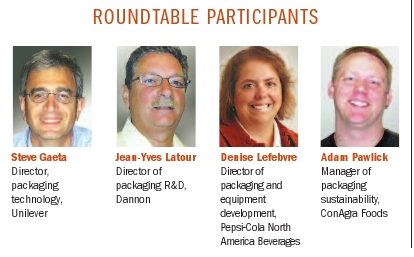
We asked packaging executives at leading food and beverage companies to don their chef’s hats and cook up some great ideas. Here’s the feast.
F&BP: What are your top challenges and/or opportunities for 2009?
Adam Pawlick:The largest challenge facing the packaging industry around sustainability is communication.
Currently, there is no standard way of communicating sustainability benefits, which has resulted in a great deal of greenwashing, both from brand owners to consumers, as well as from converters to brand owners.
A lot of good people want to do the right thing, but if they don’t understand the information they’re given, they can’t make smart choices. They either end up doing nothing, or they’re placing their bets based on partial or incorrect information.
F&BP: Adam, what is ConAgra’s solution to this?
Pawlick:It’s not a one-company solution. As the first step, we need to determine as an industry what are the standard metrics we’re going to use.
We also need to determine what’s the best way to educate consumers. Is that best done by trade associations like the Sustainable Packaging Council and the Grocery Manufacturers Association, is it done by government intervention, is it done by non-governmental organizations, is it done by independent third parties? The solution is probably going to be some combination of all of those.
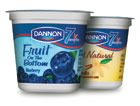
As part of a lightweighting initiative, Dannon eliminated plastic overcaps from its 6-ounce yogurt cups and now just uses foil lids.
Jean-Yves Latour: Dannon is part of Danone, a big company that is presented in multiple countries around the world. The environmental aspect of Danone’s business has been according to the agenda of our founder. So it dates back to 1970 and is part of the culture within Danone.
In other countries, we monitor what we call the pack ratio. This has been done since 2000, where we identify our major stock-keeping units, the SKUs that make up most of our volume, and then we track through the years the pack ratio, which is an expression of the packaging weight to the content of the package itself.
Within Dannon in the United States, since 2006, all of our work has resulted in a reduction of that pack ratio of 4.2%. That doesn’t look like a very big number, but when you’re trying to reduce the weight of the package, gram by gram, this is a very good result.
Through the years, we have worked in reducing the weight. Of course, there’s a big benefit of cost.
Now, we’re getting into the mode of working on the reduction of the carbon footprint of our packaging. So fundamentally, there is a change that is happening in our company at this time.
F&BP: How is this shift impacting what you’re doing?
Latour:We now have a tool that can calculate what are the expected greenhouse gas emissions of how we make our product. It goes beyond the packaging. We will be looking at the brand, at the product, holistically.
We’ve developed a tool where we fill in all the information concerning our packaging, our distribution, the energy consumption in our plants. Our suppliers for the packaging materials, in some cases, as well. And then we calculate what each product is contributing to greenhouse gases. From there, we will be able to give ourselves some objectives in the coming year.
F&BP: Denise, what about you? What are your top concerns and challenges in 2009?
Denise Lefebvre:There are a couple, and they’re intertwined: still giving the consumer surprising value through the power of design, and yet pushing the envelope of sustainability.
If you think about the economy from a value equation, we actively work with our customers on what pack formats and types will deliver the right value to our consumers. However, we don’t want that to come across as a low-quality offering. So what we need to do is deliver surprising value with great design to the consumers, and yet also meet our sustainability goals.
F&BP: How do you do that?
Lefebvre:We’re constantly advancing our proprietary technology and knowledge about our products with our bottling partners to deliver ahead of the game. We have a long-term plan-from three to five years out-on our technology platform that we hope will be an advantage for the consumer and our sustainability agenda.
Secondly, we’ve spent a tremendous amount of time in consumer insights to understand what consumers value, how design impacts them and their vision of sustainability.
F&BP: Thank you, Denise. Steve, what is the greatest challenge at Unilever?
Steve Gaeta:We share a lot of the concerns around sustainability. We’re striving to work with the industry to put some common definitions around sustainability, to preclude a lot of the confusion.
I would add some additional challenges. Material prices, while they may be coming down because of a softening in the cost of oil, are still a significant issue for us. We continue to look to optimize, because we have not been able to pass those incremental costs along to the consumer.
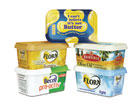
Unilever reduced its package printing color palette from more than 100 colors down to just six-without losing any shelf impact.
Gaeta:Right. That’s a good example. That was a well publicized, global project. Where do we see costs that maybe don’t present a lot of value? Can we get the same graphic representation and pop and high-quality label in a way that we can reduce some costs?
So that’s a challenge-I’m not saying it’s a primary driver for ’09, but it’s a challenge. And some of our customers are challenging us on the one hand on sustainability and on the other hand on shelf-ready packaging.
A major thrust in ’09 will be to develop more of our secondary packaging so that it enables our customers to stock the shelves in a more efficient way, thereby reducing their costs. Shelf-ready packaging is going to be a driving force, I think, for the industry.
Pawlick:Shelf-ready is definitely a growing area. More retailers are beginning to demand it, in more areas than they have in the past. They’re venturing out of the shelf-stable area and beginning to do shelf-ready in the refrigerated and frozen area.
It’s actually created a situation where there is some proliferation of SKUs. If Wal-Mart wants a shelf-ready package, and Kroger and Target do not, you end up with two different SKUs, which increases costs across the board.
It’s a growing area, and we’ve just got to figure out how to maximize the positives and minimize the negatives.
F&BP: What are the positives and negatives?
Pawlick:We’ve already covered the negatives. There’s usually a sustainability hit, increased costs and SKU proliferation.
The positive for the retailer is it lowers their cost. It makes shelving the units easier, so they can get away with a little bit less labor.
Another positive for the brand owner is, it gives you more billboard. We have more marketing space with shelf-ready packaging, most of the time. That allows us additional area to communicate our brand to the consumer.
Latour:Right now, our packages provide a lot of communication surface, which is well used by marketing, and this will continue, of course. Reduction in weight so far has not resulted in a reduction of communication surface to the consumers. I think we have the proper display surface to communicate the value of our product to the consumers.
Gaeta:We’ve put a team together to address shelf-ready packaging. A lot of these things can add costs, and so we have to go back to that whole value equation and see where a change to the packaging components might add enough value so that our customer would pay a little more for it.
F&BP: What kind of change to the packaging components will add value?
Latour:It’s getting more and more difficult to lightweight our package. So we need to start thinking about changing or improving our base raw materials.
What comes to mind are the bio-based materials that are now getting more and more available in the market. We have impacted on the lightweighting, now we will be looking at the renewable content of the packaging materials.
F&BP: Obviously barrier and shelf life are important to food and beverage companies. Where do you see the future in some of the bio-based materials from a shelf-life point of view?
Latour:We need to match our properties as of today, if not improve them. So when we do tests, we compare with our current materials, of course, so there’s no risk to take on the quality and integrity of the product.

PepsiCo cut 20% material from half-liter polyethylene terephthalate (PET) bottles for several of its non-carbonated brands, including Lipton Tea.
Latour:Today we are able to get some bio-based materials that could work with some of our products. The difficulty is to be able to use them efficiently in our manufacturing systems.
There’s no trade-off on efficiency of operation. We need to be able to keep up with our production speeds. So the development is really around that. Once we reach a threshold where this becomes a reality and feasible, then we will go a little bit deeper into the product work to make sure that the packaging material doesn’t have an impact on quality and integrity of our product.
F&BP: It seems to be that the challenge is trying to balance all these things that we’ve talked about-cost versus value, and the impact on sustainability and production operations. And we haven’t even talked about innovation yet.
How is the decision made, and who is making it, about how each factor tips the balance and becomes the direction you go?
Pawlick: There are a number of different lenses. In general, we try to take a look at things from an economic lens, a social lens and an environmental lens. And it’s got to make sense for all of those. We try to operate as much as we can on a “no trade-offs” principle, especially in the sustainability world. We’re going to introduce new technologies that are more environmentally friendly. But they cannot and will not impact product quality, package quality, food safety, consumer interaction with it or economic returns. On most of our decisions, that triple bottom line view is being used to determine whether it’s a project we want to push forward.
As for who makes the decision, it’s typically a cross-functional team inside the company in conjunction with our suppliers and our customers. We talk to them and make sure that our assumption on both ends of those groups are accurate and that they buy into the story and that we’re communicating effectively.
Lefebvre:I have to agree. Certainly our decisions are made through the variety of lenses already outlined.
If one is stronger than another, we may still execute it. For example, I can think of sustainability work that we’ll do that doesn’t necessarily change the economic scenario, but it’s still good for the environment, so we would push that forward.
Pawlick:I would like to agree with that. The best situation is where you win on all accounts. By “no trade-offs,” I meant it doesn’t have to positively impact all three, but it can’t negatively impact any of them.
F&BP: How often do you win on all three counts?
Pawlick:We have just started this practice of trying to evaluate projects this way. We’re getting better at it, and I think that’s really where innovation comes in. A lightweighting project may help your economics, and it may help the sustainability portion of it. The new material technology developments may have the opportunity to really drive all three of those.
F&BP: Could you give us an example of that?
Pawlick:Sure. This past June, we introduced post-consumer recycled polyethylene terephthalate into our cPET trays for all of our frozen food lines. It’s got full approval from the Food and Drug Administration for direct food contact.
So it’s the environmental with all the benefits-the greenhouse reduction, energy reduction, the social by providing consumers a way to positively impact the environment without having to change their daily habits.
And it provides an economic benefit by building in a lag mechanism for us on raw material price adjustments. Recycled typically doesn’t have large swings. Typically. It does now. The largest swings are virgin, and recycled typically lags behind those swings. So you can see it coming.
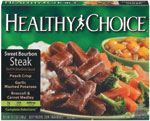
Trays for ConAgra's Healthy Choice and other frozen meals now use between 30% and 40% post-consumer recycled material.
Gaeta:We’re constantly optimizing our secondary packaging to reduce the amount of corrugated. While it’s recycled fairly well and has a good end-of-life, we’re still trying to eliminate as much of it as possible.
Lefebvre:A significant part of our portfolio is aluminum beverage cans. Those are recycled at a high incident rate, and you’ve probably seen a recent commitment by the aluminum industry to drive those rates even higher. We think that’s a huge opportunity as well. So we’ve partnered with industry and also our suppliers to drive up the recycled-content rate in aluminum packaging.
In our secondary component packaging, our crates are a capture system where we can reuse them for multiple trips. And we’ve increased post-consumer recycled content in areas such as shrink film. We look across the board holistically.
Latour:A big difference that I see between North America and other countries is the design of the shipping container or the corrugate box. We are one of the only countries that has a completely enclosed box. In many countries of Danone, the yogurts are shipped in an open tray. When you compare the usage of corrugate between the open tray and the closed box, you’re using about 30% more corrugate to ship your containers.
F&BP: Why does North America prefer the completely enclosed box?
Latour:Our distribution systems have grown that way, and today that’s the norm. We do have a few trays on the market, mostly in the club businesses, and these work fine. But when we try to introduce the idea into retail, it’s very difficult for the distribution systems to think of working with an open tray. The first fear is: What happens if you put the case on the side? Then the product will fall out.
We will be proposing some projects to some of our customers and try to experiment with that, and, hopefully, open that option for the future.
Introducing an open tray into the distribution systems of today is a big change in operations and habits. We need to do proper tests.
F&BP: What about the convenience and functionality aspects of packaging?
Pawlick:Functionality is such a wide-ranging topic. It covers product and package quality, shelf-life extension, consumer interaction, damage reduction.
We have taken the attitude of looking at everything we do and matching it to specific needs, to the specific performance criteria, to build the function out. On the secondary packaging side, we’ve taken a look at all of our corrugated again just recently and verified, are we in the right specs for the pallet pack? Do we have the right compression strength? Can we downgauge a bit? Do we actually need to go up and get rid of some of the damage issues we have?
As far as convenience, consumers are always demanding more convenient items with higher quality. A great example of that is both the Café Steamers and the Fresh Mixers products we launched in 2008. They provide convenience to the consumers by being a meal that they can take on the go. They provide an improved performance for the consumer. He gets better quality food out of it, as well as delivering the cost-value proposition they’re looking for.
Gaeta:As Adam said, these continue to be consumer trends. Some products that we’ve launched are innovations that speak to convenience and functionality. They’ve done very well in the marketplace. We see consumers continuing to shop the periphery of the store to buy fewer ingredients for scratch cooking, and looking for prepared and assembled meals.
Bertolli frozen dinner for two is a good example. It’s a restaurant-style meal that you put in a skillet. It’s prepped in a few minutes. There’s still this consumer need for portability, convenience, but not at the expense of quality. That’s been the shift. Convenience was a primary driver several years ago, and consumers were willing to maybe have a little less quality, because convenience was so important. But now that there are a lot of options, consumers are differentiating again.
F&BP: Do you see that trend still continuing, Steve, based on the economic situation the country is in now?
Gaeta:I do. Because…we also have a foodservice group. What we see is, high-end restaurants may suffer a bit with the economic situation. People are eating out a little bit less. But what some of our convenience food items do is, they don’t radically change your lifestyle, but give you some options. It’s still a reward in a hard economic times to treat the family. Where you might have gone out before, now you can bring some food home. We still see the segment being very strong. For different reasons, but still very strong.
Lefebvre:Regarding shelf impact and design, PepsiCo has really embraced that. This year, we have been unleashing the power of design across our portfolio to talk about surprising value for the consumer, to reconnect with our consumers and reinforce the brand message-and really excite them at the first moment of truth and every time they use our product.
Our new brand identity across our carbonated soft drink portfolio is a first step in a journey for us of reconnecting with our consumers, and really reinforcing the brand message and promise with them. That’s an exciting program that we’re just seeing coming to the marketplace.
We’ve worked hard in having great design play a significant role in its attractiveness and its relevance to the consumer.
For example, we’re rolling out nationally Lipton gallon jugs. It offers surprising value with great functionality for the consumer. It’s the first large-scale cantilevered handle execution in the United States that’s fully recyclable.
We did a lot of consumer research in terms of optimizing that for the consumer in the refrigerator and their usage occasions, and delivering on the promise of the high-quality Lipton brand message.
We’ve strategically had to operate within our asset base and footprint. And our customers are very excited about it as well.
Gaeta:Design is very important. You can have the best product, but if consumers don’t notice it on shelf and it doesn’t pop, it isn’t going to make it home.
Earlier we talked about our printing project. We feel that sometimes there are opportunities where we can achieve the same impact and still reduce some costs. F&BP
WEB EXCLUSIVE: Polypropylene recycling
F&BP:You’ve all mentioned PET recycling. What about trying to develop recycling infrastructures for other packaging plastics?Gaeta:Polypropylene would be a good plastic to encourage recycling on.
F&BP:How do we go about doing that?M
Gaeta:I think it goes back to communication and to show a value that it can be collected and done so economically. Polypropylene is an important packaging plastic for the food industry. So to legislate away from it at the moment isn’t the wisest thing, because it does have a specific purpose that other plastics can’t achieve. So it would be good to encourage recycling of it and reuse of it, rather than ban it.
Pawlick:I agree completely on polypropylene. It’s definitely one material that the packaging industry needs to focus on getting a better end-of-life solution for.
As brand owners, one of the ways we can encourage that is by working with specific recyclers to prove out the process to recyclers, and then also show value in it. What could we use it in? Because, again, it’s basic economics-supply and demand. If I start saying I want 25 million pounds of recycled polypropylene, there’s value to it. Somebody is going to step up and start collecting and recycling.
ConAgra is trying to take a more proactive stance and say, “How can I prove out that technology and provide a value-added product made with that?”
Lefebvre:PepsiCo is committed to working with our recycling partners and our suppliers to continue to drive that forward. We actually sit on the technical committee of the American Plastics Recyclers to have input there and get feedback with that committee, and outreach to the committee as well from a marketing perspective. So we drive it on a number of fronts.
We also do a lot of customer programs. With Sam’s, we’ve had a really successful program around “Return of Warmth” where people return their PET bottles, and then we work with them to get those to the right manufacturers to make fillers for coats and things of that nature. So there’re other ways to do it.
F&BP:It sounds like the best success is when it’s a collaboration among various partners in the entire supply chain.
Pawlick:Yes. Correct.
Gaeta:Yes.
F&BP:It also sounds like the brand manufacturers are taking the initiative in creating these partnerships.
Lefebvre:Yes, the brand owners are leading a good portion of the way. But you also see other parts of the supply chain recognizing it and developing new offerings as well. I’d be remiss to say that our packaging material suppliers don’t try to proactively partner with us. There are multiple people all stepping up to the plate in their own area to make those linkages.
Pawlick:The biggest success has come when there is a partnership across the entire value chain. So when the resin manufacturer gets with the converter, who gets with the brand owner, who gets with the retailer, who all do consumer studies in development technology to drive a true intangible difference, those are the big wins.
WEB EXCLUSIVE: Cost of recycled content material
F&BP:How does the vision that consumers have on sustainability reflect perception versus reality?Lefebvre:It’s mixed. I would agree with Adam from the standpoint that there’s a lot of confusion among consumers, and retail customers as well. There’s confusion about what would work for them. Think about the Wal-Mart sustainability card and how we measure against that, versus what a consumer’s perception is of sustainability. We have to service all of those. Getting to a common win for both of those constituents is really important to us. We’re trying to balance between the two.
For example, this past year we launched our lightweight non-carbonated bottle in half-liter for Lipton iced tea, Aquafina FlavorSplash and Tropicana juice drinks. That ended up being a significant win for us across the portfolio. We reduced overall packaging by 20%. We were able to get a more efficient package for our bottling system. It provided greater refreshment cues and greater quality cues in consumer research. And it also delivered customer needs in terms of advancing their sustainability agenda significantly and making PepsiCo a premier partner to work with in this area.
WEB EXCLUSIVE: Consumer's vision of sustainability
F&BP:One of the things I’ve heard is that recycled resin might be less attractive because virgin material costs are coming down. Do you think that the sustainability benefits will continue to keep recycled-content use up?Pawlick:The more brand owners use recycled content, the economics are going to play better for the recyclers. The environmental benefit is definitely going to keep recycled plastics, and the use of recycled plastics, in there, and as the use of recycled plastics grows, the economic portion of it is going to get even stronger.
Lefebvre:At PepsiCo, we’ve had 10% post-consumer content PET in our portfolio for quite some time, as an average across our business. We’re still committed to do that. We wouldn’t foresee a change around that.
Pawlick:The other benefit of driving the recycled forward is that it actually helps drive a better end of life. So right now, recycled PET is less than 30% of the total PET waste stream. The more that brand owners start demanding that, the more that ConAgra starts using more recycled PET, Pepsi starts driving more recycled PET into their systems, it’s going to encourage better collection, because, again, there’s a place for those recyclers to sell it into and make money.
If nobody’s going to use the end product recyclers are making, that’s when the economics start falling apart. Recyclers start dropping, and you can’t really drive that as a continuous business. So the more we use it, the more it’s going to drive collection, the higher that 30%’s going to rise.
Gaeta:I don’t disagree. From another perspective on it, because you mentioned cost, is that as long as we participate as an industry to encourage recycling, and keep a good material like PET out of the waste stream, keeping it from going to the landfill, it doesn’t necessarily have to come back into a food package container, while there are alternative streams that are using virgin resin.
As long as we design the package to encourage and facilitate recycling, that’s the primary thing. And then, if it makes more sense to take recycled PET and make a rug out of it, and shift the virgin material which those manufacturers may be using to food packaging, I don’t see a problem with that-as long as we’ve kept it out of the landfill, where it has no value.
