
Consumers are green but cheap
Tiff over COOL heats up
Tomato-based film fights E.coli
Meal kit nukes in package
Bar code links consumers with info

by Pan Demetrakakes
Executive Editor
The controversy over bisphenol A (BPA), a plastic additive commonly used in bottles and metal can linings, shows no signs of abating, even in light of continued assertions by the Food and Drug Administration that the substance poses no threat.
BPA is a hardening agent used in polycarbonate bottles and in the epoxy linings of metal food and beverage cans. An industry group estimates that more than 90% of the food cans used in the United States contain BPA.
The FDA held a hearing last week in which it held, at least for now, to its position that BPA in packaging poses no threat to consumers. “Right now, our tentative conclusion is that it’s safe, so we’re not recommending any change in habits,” Laura Tarantino, head of the FDA's office of food additive safety, said at the hearing.
But warnings about possible harm from BPA keep coming. A recent study, published in the Journal of the American Medical Association by two professors who are long-standing critics of BPA, linked the chemical statistically with heart disease and diabetes, as determined by the amount of BPA in subjects’ urine. Earlier studies have suggested a link between BPA and certain types of cancer, as well as problems with the prostate gland and reproductive organs.
Other countries have moved to reduce BPA exposure. Canada has banned the use of the substance in baby bottles. Japanese food processors voluntarily reduced the amount of BPA in their cans starting in 1998, substituting either a coating made from polyethylene terephthalate (PET) or one that contains BPA but allows less migration into the product. Several U.S. states are also considering BPA bans.
Even the FDA seems tentative about vouching for BPA. At the conference last week, Tarantino offered tips for reducing BPA exposure, such as reducing the use of canned foods and not microwaving food inside plastic containers.
BPA would seem to be untouchable because of its ubiquity.Ball Corp., one of the largest U.S. suppliers of food cans, has only one customer for its non-BPA food cans, a relatively small organic processor in Michigan. But if the scary studies keep coming, some kind of market backlash is inevitable. It will take the form of either a canned food processor who cuts out BPA-gambling that consumers will find the increased cost (about 2.2 cents more per can) worth it-or a supplier who offers a non-BPA can lining that performs as well as standard ones.
TOP DEVELOPMENTS
Consumers are green but cheapConsumers are increasingly interested in benefiting the environment, but that interest does not translate into willingness to pay more for products, according to a new survey. The “Going Green 2” poll, byYankelovich Inc., said that while the number of consumers who express “high levels of personal concern” over the environment is increasing, it still stands at a minority (41%). The study also noted that “they are becoming less willing to help marketers pay for the greening of their business and products," says Yankelovich spokesperson David Bersoff.
Tiff over COOL heats up
Meatpackers and farmers are at odds over a wrinkle in Country of Origin Labeling (COOL) regulations. The U.S. Department of Agriculture is interpreting the rules, which are scheduled to go into effect Sept. 30, as allowing several countries to be listed on a label as possible points of origin, such as “Product of USA, Canada or Mexico.” Tyson Foods and other major meatpackers say this is a cost-effective way to cover products made from animals whose ranks may include a few non-U.S.-raised ones. But American farmers and ranchers object that allowing such piggyback labels is a loophole that subverts the intent of COOL.
Tomato-based film fights E.coli
An experimental edible film made from tomatoes and oregano extract has been shown to inhibit the growth of E.coli O157:H7, according to an article recently published in theJournal of Food Science. The film was developed and tested by the Agricultural Research Service of the U.S. Department of Agriculture. It is made from tomato puree and contains carvacrol, the main ingredient in oregano oil, which is an established “natural” antibiotic. The experiment showed that E.coli growth was inhibited on plates with film that had 0.75% to 1% carvacrol.
NEW PACKAGES
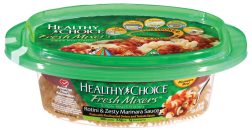
Meal kit nukes in packageA new shelf-stable meal kit from ConAgra Foods allows consumers to microwave starch-and-sauce combo meals without removing the product from the package. Healthy Choice Fresh Mixers are packaged in a plastic tub with rice, pasta or noodles plus a packet with sauce. The top of the lid is perforated with holes, which are exposed when the consumer peels a film cover off the lid. The consumer removes the sauce pouch, adds water to the tub, replaces the lid and microwaves the starch. For products with rice, the holes vent steam while the rice absorbs the water. With pasta, the lid serves as a strainer when the consumer inverts the tub to drain the water. The consumer then microwaves the sauce pouch and mixes the sauce into the cooked starch. Healthy Choice Fresh Mixers come in five varieties: Ziti and Meat Sauce, Rotini and Zesty Marinara Sauce, Szechwan Beef with Noodles, Sweet and Sour Chicken with Rice and Sesame Teriyaki Chicken with Rice.
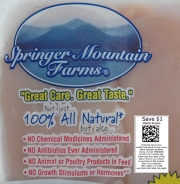
Labeling on fresh chicken sold in the South includes a bar code that consumers can use to download promotions, recipes, FAQs and other information. Chicken processed by Springer Mountain Farms, Mt. Airy, Ga., bears a two-dimensional bar code that ties into technology fromGraphic Packaging Int’l. The technology, trade-named Snap2C, allows consumers to scan the code with a camera-equipped cell phone to link to promotional and consumer information on Springer Mountain Farms’ website. The program was rolled out in the Atlanta area in July and will go national in November.
